
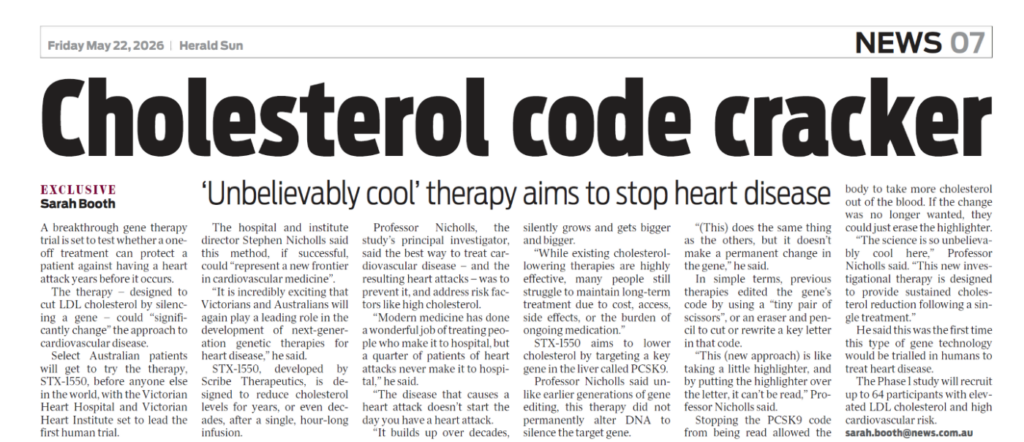
The Victorian Heart Hospital and the Victorian Heart Institute will lead a first-in-human clinical trial of a new investigational genetic therapy that aims to lower cholesterol in people at increased risk of cardiovascular disease.

The trial will be led by Monash University’s Victorian Heart Institute, which serves as the study’s academic and operational lead.
The therapy is designed to reduce LDL (‘bad’) cholesterol by silencing a gene in the liver called PCSK9, a well-established regulator of cholesterol levels and cardiovascular risk.
Elevated LDL cholesterol is a major cause of atherosclerotic cardiovascular disease, including heart attacks and strokes.
STX-1150 uses a next-generation CRISPR-based approach known as epigenetic silencing.
The therapy is being evaluated as a single-dose infusion and is designed to reduce cholesterol levels for years without permanently altering a person’s DNA.
Professor Stephen Nicholls, Principal Investigator of the study and Director of the Victorian Heart Hospital and Victorian Heart Institute, said the trial represented another major step forward in developing more durable approaches to cardiovascular prevention.
‘The best way to treat heart disease, the leading cause of death globally, is to prevent it,’ Professor Nicholls said. ‘While existing cholesterol-lowering therapies are highly effective, many people still struggle to maintain long-term treatment due to cost, access, side effects, or the burden of ongoing medication.’
‘This new investigational therapy is designed to provide sustained cholesterol reduction following a single treatment, with the potential for effects lasting years or even decades. If successful, this approach could significantly change how we manage cardiovascular risk and represent a new frontier in cardiovascular medicine.’
‘It is incredibly exciting that Victorians and Australians will again play a leading role in the development of next-generation genetic therapies for heart disease.’
The Phase 1 study will assess the safety, tolerability and biological effects of STX-1150 in adults with elevated LDL cholesterol who are at increased cardiovascular risk.
The trial plans to enrol up to 64 participants across sites in Australia and New Zealand, with participants monitored for one year following treatment.
With regulatory clearance now secured from Australia’s Therapeutic Goods Administration, the study will be initiated and builds on growing international interest in genetic approaches to cardiovascular disease prevention.
About the study
- The Phase 1 trial will evaluate STX-1150 in adults with elevated LDL cholesterol and increased cardiovascular risk.
- The study is designed as an open-label, single ascending dose trial followed by a dose expansion phase.
- Up to 64 participants are planned to be enrolled across Australia and New Zealand.
- The Victorian Heart Hospital will serve as the first clinical trial site.
- Participants will be followed for one year after treatment.


