
AI boosting cancer clinical trials
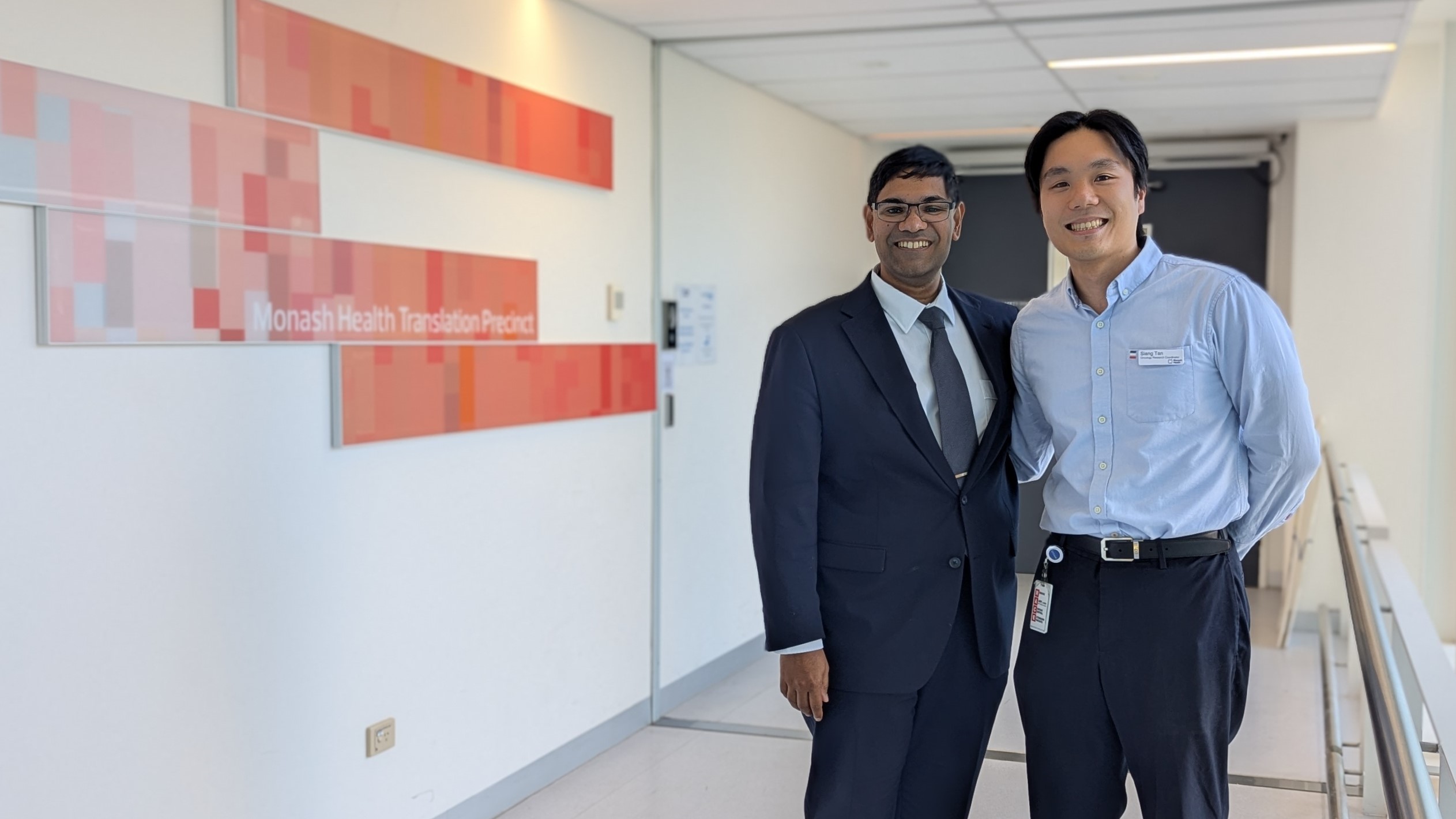
(Left) A/Prof Arulananda and Oncology Research Coordinator Suan Siang Tan
Thanks to the power of artificial intelligence (AI), cancer clinical trials are recruiting more patients quicker and more accurately, bringing timelines forward.
A study has found that an AI software helped identify more eligible cancer patients in a shorter timeframe for three clinical trials at Monash Health.
The AI software, applied within the Victorian Cancer Registry (VCR) – which is a population-based cancer registry – has demonstrated remarkable accuracy in identifying eligible patients for clinical trials.
By auto-extracting key clinical data from pathology reports, the AI software has increased the number of participants approached for trial enrolment by 50% compared to traditional hospital-based recruitment methods.
Deputy Director of Medical Oncology and Thoracic Oncology Trials Lead at Monash Health, Associate Professor Surein Arulananda, who was a co-author on the study, highlighted the potential of this AI approach to revolutionise clinical trial recruitment.
‘It may be a game changer if the algorithm can be expanded to include radiological findings and other key patient characteristic data and then be scaled up,’ he said.
A/Prof Arulananda shared one notable success story involving the adVan-Tig 302 study, an international multi-centre trial aimed at improving survival outcomes for lung cancer patients.
He said the AI software, E-Path Plus, which was designed by oncology informatics company Inspirata, identified a potential participant even before they were seen by an oncologist, allowing for expedited management plans and earlier trial enrolment.
However, implementing AI in clinical trial recruitment is not without challenges.
A/Prof Arulananda acknowledged the importance of ensuring confidentiality and privacy of patients as required by privacy and health record legislation.
He said a coordinator is also needed to review the cases identified by the AI software in advance to ensure compliance.
A/Prof Arulananda added that the software is being fine-tuned, and the research team is planning for larger studies.
Despite these challenges, the result of this study is promising.
The AI program demonstrated an accuracy of 93% and an F1 score (a machine learning accuracy evaluation metric) of 0.94 out of 1.0 in extracting key clinical variables from pathology reports.
The standard hospital approach meanwhile selected fewer cases for clinical trials compared to the AI approach, highlighting the potential of AI to improve recruitment efficiency.
As this approach continues to evolve, it holds the promise of faster, more efficient clinical trial recruitment, ultimately leading to better outcomes for cancer patients.


