
When 50-year-old Shane Allan collapsed at his home, his wife immediately suspected he had had a stroke.
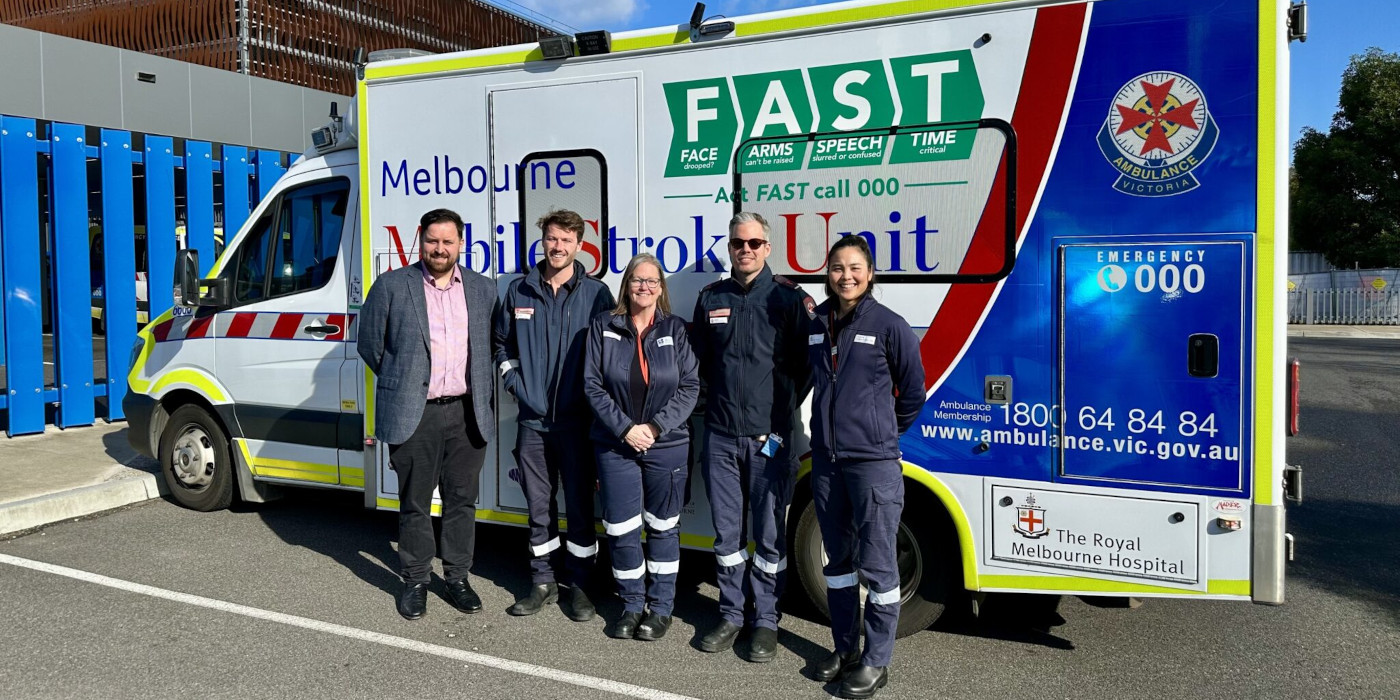
‘Shane was in the ambulance on the way to hospital and on the way, they were met by the Mobile Stroke Unit. It’s fantastic.’ Michelle Allan
As reported by Cranbourne Star News, unbeknownst to the couple, who live in the Victorian town of Cockatoo, Australia’s second Mobile Stroke Unit (MSU) had begun operating out of Dandenong 3 months earlier. It was able to provide rapid and life-saving stroke care.
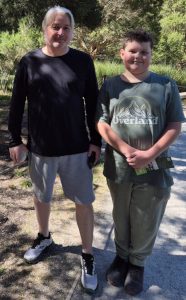
A hospital-grade CT scanner onboard the Mobile Stroke Unit enabled the specialist team to swiftly diagnose Shane with a blockage in an artery, known as an ischemic stroke, at the side of the road. They could quickly begin treatment, thanks to a range of stroke medications stocked onboard the MSU. After administering a clot-busting medication, the team took Shane to Monash Medical Centre in Clayton, the nearest hospital equipped to do clot retrieval.
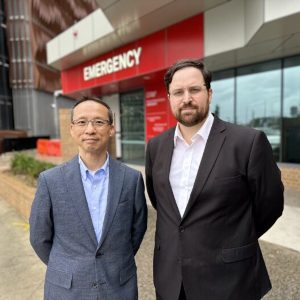
‘Not every hospital can do this procedure. You’re potentially preventing hours of delays if you can get a patient to a stroke service straight away,’ said Professor Henry Ma, the Director of Neurology at Monash Health. ‘Every minute you lose about 2 million brain cells. So, every minute you save helps a patient.’ Doctors at Monash Medical Centre were notified of Shane’s diagnosis before he arrived. This gave specialists time to prepare and meant he could be taken in for surgery fast.
‘The result of his care was very good,’ said Monash Health neurologist, Dr Michael Valente. ‘Being able to restore blood flow quickly means Shane’s now back to independent function and home again.’ The father-of-one underwent rehabilitation and has returned to work. ‘I have a slight bit of weakness on my left side, but that’s mainly it,’ said Shane.
Improving survival rates
Victoria’s second Mobile Stroke Unit operates within a 20-kilometre radius of its base near Dandenong. At times, it can rendezvous outside that catchment area. It is dispatched by Ambulance Victoria to patients with suspected stroke, and operates Monday to Friday from 8 am to 6 pm. Monash Medical Centre is its primary receiving site.
The hospital is a world-class stroke care centre, providing clot retrieval services to patients from around Melbourne’s south-east and across Victoria. ‘We are thrilled to have Australia’s second Mobile Stroke Unit operating in our catchment. We believe it will improve functional outcomes for stroke patients in our community. We are already seeing excellent patient outcomes,’ said Professor Ma.
‘With the MSU we are getting a lot more information about patients before they arrive at the hospital. So, our team can be ready for patients when they arrive, and some are even able to go direct to our angio suite to have the clot removed.’
The hospital at your doorstep
When Dr Valente is not working at Monash Health, he supports the work of the MSU as a virtual neurologist, based at the Royal Melbourne Hospital (RMH). ‘It’s extremely satisfying and humbling to be able to help the patient from their house. You’re shifting the dynamics of their care dramatically,’ said Dr Valente. ‘Sometimes you can see the effect of the drugs that you’re giving straight away, you can see the stroke resolving before your eyes. It’s incredibly rewarding to see.’
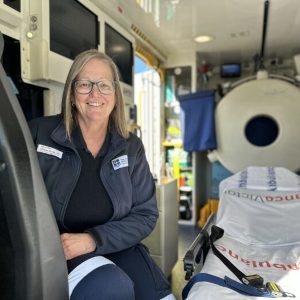
A former Stoke Clinical Nurse Consultant at Monash Health, Jodie Rabaut, is enjoying applying her skills as a Stroke Nurse Practitioner for RMH on the MSU. ‘The benefit of the MSU is to hopefully be at the patient in the community within the “golden hour” of stroke onset. The first 60 minutes is critical and where treatment is the most effective and leads to better patient outcomes,’ said Jodie. She is applying the same skills she uses in the hospital setting, but in a very different environment. ‘Being out in the elements, rain, hail or shine and providing imaging and treatment on the street is a rawer experience.’
‘In the hospital environment, the patient arrives with paramedics on a stretcher with all the required information. With the MSU you are entering people’s homes, where they may be stuck between furniture, and you are sourcing as much information as you can, all the while trying to comfort family members during such a confronting time.’
‘Working with such a tight-knit team on the MSU, including paramedics, radiographers and doctors, knowing that you are helping people in the community, is definitely satisfying and rewarding.’
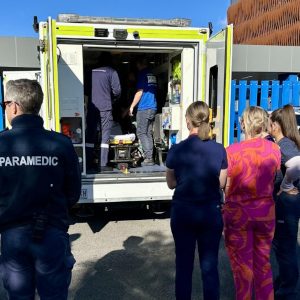
During National Stroke Week (4-10 August), staff at Monash Medical Centre welcomed the opportunity to view the facilities on board the MSU and speak with the team about their work.
The Mobile Stroke Unit is a collaboration between:
- Ambulance Victoria
- The Royal Melbourne Hospital
- Victorian Government


