
Updated guidelines for Premature Ovarian Insufficiency published in three leading journals
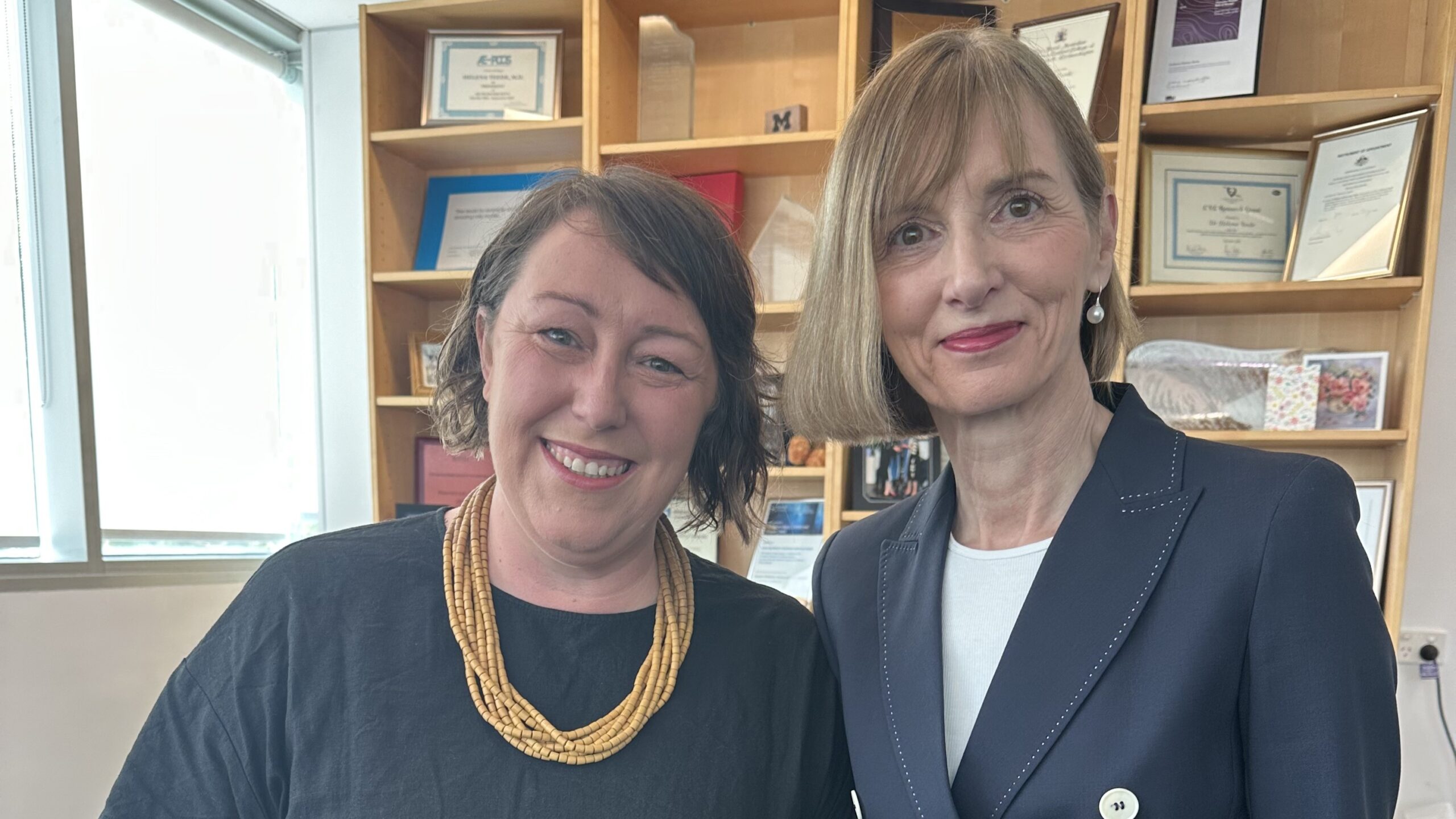
Associate Professor Amanda Vincent (right) with Kirsty who has lived experience of POI and worked with the team to develop the new resources.
Updated guidelines on diagnosing and managing a condition when a woman’s ovaries stop working before she is 40 have been published in Climacteric, Fertility & Sterility, and Human Reproduction Open journals.
The condition called Premature Ovarian Insufficiency (POI) occurs much earlier than the usual age of menopause, which typically presents itself at an average age of 48 to 51 years in women globally.
POI affects approximately 4 per cent of women globally and is associated with infertility, psychological distress and an increased risk of osteoporosis, cardiovascular disease, mortality, dementia and cognitive dysfunction.
While hormone therapy has been shown to mitigate some of these effects, the management of POI globally remains sub-optimal with delayed diagnosis, variation in care and patient dissatisfaction.
The multidisciplinary Monash Health Menopause clinic provides specialist care for women with POI and collaborates in research projects related to POI, which contributed to the evidence underpinning the new guideline.
Monash Health Endocrinologist Associate Professor Amanda Vincent co-chaired the international guideline development group, which involved a partnership between Monash University’s Centre for Research Excellence in Women’s Health in Reproductive Life (CRE-WHiRL), which is led by the Monash Centre for Health Research and Implementation, the American Society for Reproductive Medicine, European Society for Human Reproduction and Embryology, and International Menopause Society.
Another Monash Health endocrinologist, Professor Helena Teede AM, is a member of the guideline development group and co-author of the published papers.
Associate Professor Vincent says a key change of the updated 2024 guidelines is the recommendation regarding the diagnosis of POI; only one elevated follicle-stimulating hormone (FSH) level is needed to be combined with irregular or absent menstrual periods for at least four months.
The FSH level only requires repeating if the diagnosis remains unclear. Women with lived experience provided recommendations on how to convey the diagnosis and care of women with POI.
‘The new guideline means faster diagnosis of POI, conveyed sensitively and involving shared decision making between the healthcare professional and the woman experiencing POI,’ says Associate Professor Vincent.
She adds that a comprehensive clinical evaluation requires more than assessing symptoms.
‘It must also include asking a patient about her sexual wellbeing, fertility needs, psychological health, cardiovascular and osteoporosis risks, and co-morbidities,’ she says.
The updated guideline stresses the importance of personalised hormone therapy for symptom relief and chronic disease prevention, with the need for prompt implementation and continuation until the usual age of menopause.
‘This provides healthcare professionals with clear advice on best practices in POI care, based on the best evidence currently available,’ Associate Professor Vincent says.
The 2024 guidelines provide 145 recommendations on symptoms, diagnosis, causation, sequelae (an after-effect of the condition) and treatment of POI.
An international survey of women and healthcare professionals informed the guideline’s topics. New information is provided about the genetic causes of POI, the impact of POI on muscle health, the use of the Anti-Mullerian hormone, non-hormonal therapies, lifestyle interventions, and complementary therapies.
The POI guideline is accompanied by co-designed resources for consumers, including an updated Ask Early menopause App, which Associate Professor Vincent developed, and a toolkit for health professionals.
The Ask Early Menopause App informs and supports women in managing early menopause with evidence-based resources, a personal dashboard, and a discussion forum. It has over 9,000 users worldwide. The full international POI guideline is available here.
Congratulations to Associate Professor Amanda Vincent and Professor Helena Teede AM on your work for advancing better care for women globally.


