
Monash Health’s Clinical Trials Centre marks 10-year anniversary
- Clinical Trials
- 5 min read
A decade on, Monash Health’s Clinical Trials Centre is helping bring promising new treatments from the lab to the bedside, giving patients more options, sooner. Here’s how the team is shaping what comes next in healthcare.
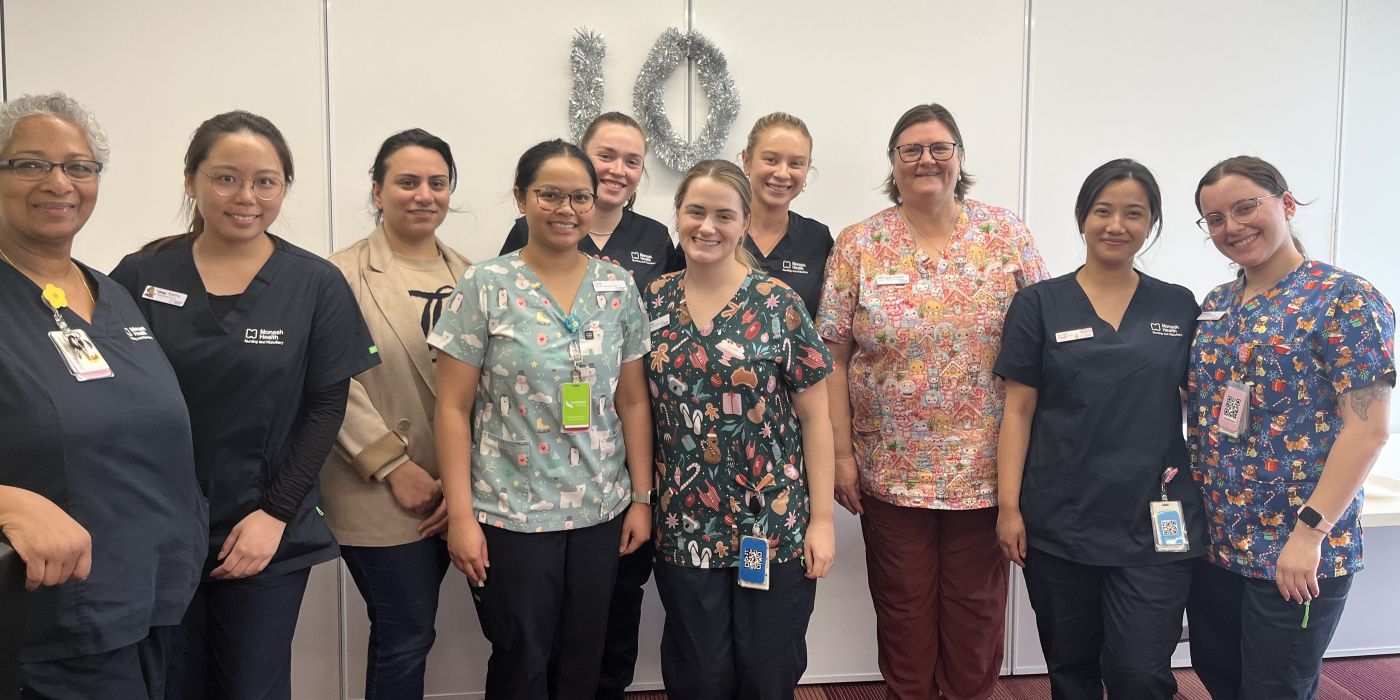
Since then, the Monash Health Clinical Trials Centre (CTC) has expanded from 5 specialty units to support trials in 33 different areas of medicine, supporting over 350 current trials, and is now planning a transition to 24/7 operations.
From five units to 33 specialties
When it opened, the CTC brought together five foundation units under one roof: Oncology, Haematology, Gastroenterology, Nephrology, and Lung & Sleep (now Monash Lung, Sleep, Allergy & Immunology – MLSAI).
The idea was simple but ambitious. Create a coordinated, multidisciplinary clinical research hub where patients can access cutting-edge therapies, and where clinicians, scientists, and trial sponsors can work side by side.
Based within the Monash Health Translation Precinct (MHTP) at Clayton, the CTC is a partnership between Monash Health, Monash University and the Hudson Institute of Medical Research. The location was deliberately chosen to sit at the intersection of clinical care and laboratory science.
A decade on, that model has expanded dramatically. The centre now supports trials across 33 specialties, ranging from cancer and kidney disease to respiratory medicine, rheumatology, and rare diseases.
World-first research with local impact
Behind the numbers lie years of work by clinicians, trial nurses, coordinators , and scientists.
Haematology and oncology teams have led world-first and early-phase studies giving patients access to new cancer therapies years before they reach routine practice, while rheumatology and other specialties have tested novel treatments for complex immune and inflammatory conditions.
Many of these trials have gone on to shape international guidelines and bring new drugs to market, but for patients, the impact is often very personal.
Effie’s story: ‘She wasn’t going to give up hope’
When Effie Atkins was told in 2017 that there were no further treatment options for her liver cancer, she refused to accept that nothing more could be done.
‘She wasn’t going to give up hope and through research she did on her own, discovered that a clinical trial was being run at Monash Health in the CTC. Effie enrolled, commenced treatment, and is now cancer-free,’ said the manager at the Clinical Trials Centre, Monique Pedetti.
In the years since, she has become one of the centre’s strongest advocates, founding the Dr Hope Foundation to raise funds for Monash Health Cancer Trials and the CTC.
Monique Pedetti, who has been at the CTC since its inception, said Effie’s story has inspired other patients to ask about clinical trials and to consider options beyond standard care.
‘Effie is a beacon of light and hope to many in our community,’ Monique Pedetti said. ‘She reminds us that behind every trial number is a person, a family, and a future.’
It’s changed the face of clinical trials
For Nephrology Research Manager Jo Nandkumar, who was involved in setting up the centre, the past 10 years have been transformational.
‘The CTC has changed the face of clinical trials at Monash Health and certainly for nephrology,’ she said.
‘This space has allowed us to take on phase 1 studies, a considerable learning curve, and then expand into phase 2 trials, giving our rare disease patients the chance to access new therapies much earlier.’
Clinical Director of Monash Haematology Professor Jake Shortt, who was involved in numerous landmark studies at the CTC, said the centre leads the world in first-in-human trials that have reset the international treatment landscape.
‘The CTC facilities are world-class and as good as anything you will find in terms of clinical trial facilities in Australia. The setup allows for all phases of research, from first-in-human studies to cellular therapies, with dedicated equipment, nursing, and pharmacy staff to enable the most sophisticated trial protocols to be performed,’ he said.
‘The co-location of CTC with Monash University’s academic research laboratories in MHTP strengthens the capacity for scientific discovery. When the facility opened in 2015, it transformed our ability to secure the best possible clinical trials for our patients and deliver high-quality care.’
New tools, new frontiers, including AI
As the centre enters its second decade, technology continues to reshape how trials are designed and delivered.
Artificial intelligence is starting to play a role in areas such as imaging analysis, patient selection, and data management, with Monash Health clinicians and researchers exploring how AI can help identify suitable participants more quickly and track outcomes more efficiently.
Oncology and other teams are already involved in projects that combine traditional clinical trials with advanced analytics, aiming to match patients to therapies with greater precision while maintaining strict safety and ethical standards.
‘This is an exciting frontier, where we have the opportunity to expand our collaboration with university and industry partners to develop and deploy technology that allows us to fast track drug discovery and development, whether using MAVERIC, Monash University’s supercomputer, to run trials in simulation or using our dataset to build patient digital twins that assist with adverse events and risk prediction,’ said Director of Research and Innovation Associate Professor Tam Nguyen.
Looking ahead: towards a 24/7 trials centre
The next chapter for the CTC is an ambitious one.
A proposal is under development to extend operating hours to include public holidays and eventually transition to a 24/7 centre.
CTC manager Monique Pedetti said the change would:
-
Improve flexibility for participants who juggle treatment with work and caring responsibilities
-
Support strict trial protocols that require infusions or monitoring at set times
-
Reduce congestion in outpatient clinics and on inpatient wards
-
Maintain high standards of safe, closely monitored participant care
A round-the-clock trials centre would also be a strong drawcard for Australian and international sponsors, potentially bringing more studies and more options to patients across the region.
A place where hope meets hard science
As the centre marks its 10-year milestone, Pedetti said what matters most is not the number of protocols or sponsors, but the people who come through the doors each day.
From first-in-human studies to late-phase trials that put the final pieces of evidence in place, the CTC has become a place where patients can try tomorrow’s treatments today, under the watchful eye of experienced clinicians and nurses.
For Pedetti, the goal remains clear.
‘Every trial visit is about safety, dignity and hope,’ she said. ‘We’re here to give our patients real options and to help bring better treatments to the people who need them, sooner.
‘It’s a privilege to walk alongside them as they place their hope in research that may change not only their own lives but the lives of others in our community and beyond.’
Congratulations to the CTC team for 10 wonderful years of far-reaching impact on our community and for people around the world!


